

TL;DR:
- A scooter adventure workflow involves route planning, packing, riding tactics, and troubleshooting to ensure safety and efficiency. Skipping these steps often results in range anxiety, unstable loads, or mechanical issues, especially on coastal and hilly routes. Proper planning and disciplined execution help riders complete trips smoothly and avoid common failures.
A scooter adventure workflow is a systematic process that covers route planning, packing, navigation, and riding tactics to help travelers complete urban and coastal trips safely and efficiently. Most riders skip the workflow and pay for it with range anxiety, unstable loads, or mechanical surprises on remote roads. A structured approach solves all three. This article covers the full two-wheel adventure workflow from pre-ride prep through real-time troubleshooting, with specific guidance for destinations like Thessaloniki and Halkidiki where terrain and coastal conditions demand honest planning.
What does a scooter adventure workflow actually involve?
A scooter adventure workflow covers six sequential stages: route research, range calculation, packing, pre-ride inspection, active riding tactics, and field troubleshooting. Each stage feeds the next. Skipping route research, for example, makes range calculation unreliable. Skipping packing discipline makes the scooter unstable on coastal switchbacks.
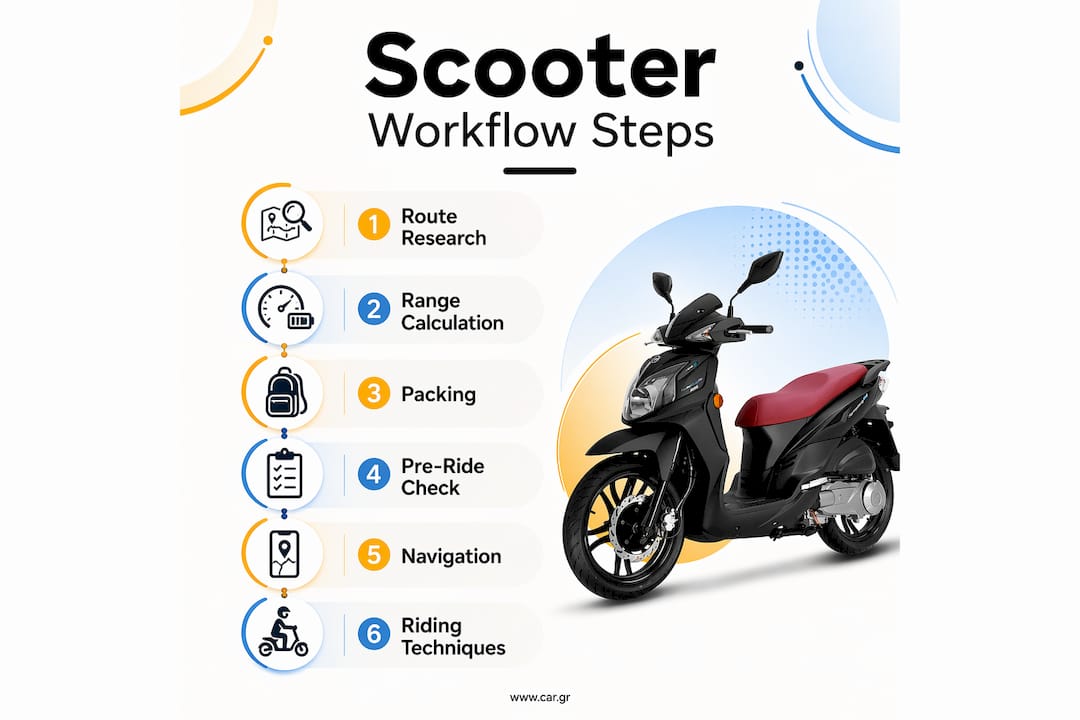
The workflow applies equally to electric and internal combustion scooters, though the specific numbers differ. For electric models, rated range drops 30–40% when you account for elevation, wind, rider weight, and surface type. That means a scooter rated at 60 miles realistically delivers 36–42 miles in mixed terrain. Plan every route around the real number, not the spec sheet number.
The workflow also applies to the rental process itself. Modern rental platforms use QR code scanning, backend identity verification, IoT command transmission, and hardware unlock in sequence. Understanding that four-stage process helps travelers budget time correctly, especially when connecting scooter legs with other transport modes.
How to plan realistic scooter routes and manage range
Route planning is the stage where most trips succeed or fail before the rider even sits down. The goal is matching the route's demands to the scooter's real-world capabilities.
Follow these steps in order:
- Pull the rated range and apply the 30–40% reduction formula. A 50-mile rated range becomes a 30–35-mile working range in hilly or coastal terrain.
- Map elevation changes. Elevation gain adds roughly 20% battery consumption per 100 feet climbed. A route with 500 feet of total gain costs you an extra full battery percentage point per climb segment.
- Set a hard turnaround at 50% battery. The Half-Tank Rule applies to both electric and gas scooters. Never let fuel drop below 50% beyond urban areas. Remote refueling options disappear fast outside city limits.
- Overlay risk signals onto your base map. Navigation apps lack scooter-specific data like surface roughness and vibration scores. Add steep grades, unpaved sections, and heavy traffic corridors manually before you ride.
- Identify one contingency charging or refueling point per leg. For Thessaloniki coastal routes toward Halkidiki, gas stations thin out past Nea Moudania. Mark them before you leave.
Pro Tip: Import a GPX file of your planned route into a navigation app that supports offline maps. Ride the route virtually the night before to spot elevation spikes you missed during desktop planning.
| Route factor | Impact on range | Recommended adjustment |
|---|---|---|
| 500 ft elevation gain | Up to 20% extra battery draw | Reduce planned distance by 15% |
| Unpaved or gravel surface | 10–20% efficiency loss | Add buffer stops every 10 miles |
| Cold weather (below 50°F) | 20–40% capacity reduction | Pre-warm battery, shorten route |
| Headwind above 15 mph | 10–15% range reduction | Adjust turnaround point earlier |
What goes into a scooter trip packing workflow?
Packing for a scooter trip is not about bringing everything useful. It is about bringing the minimum that prevents the most common failures.
The core tool kit for any scooter trip packing workflow includes:
- A compact tire repair kit with CO2 inflators or a mini pump
- Hex wrenches in 4mm, 5mm, and 6mm sizes (loose bolts from trail vibration are the most common minor issue on off-road and coastal routes)
- A multi-tool with flathead and Phillips screwdrivers
- Zip ties and duct tape for temporary fixes
- A small flashlight or headlamp for tunnel sections or late returns
Weight placement matters as much as what you pack. Pack low and central using the floorboard for dense items, the underseat compartment for rain gear, and the rear rack only for the lightest items. A top-heavy or rear-heavy load shifts the scooter's center of gravity and makes coastal curves harder to hold.
Pro Tip: Use small dry bags or compression pouches instead of a single large bag. They fit into irregular spaces better and keep weight distributed rather than stacked.

Weather gear deserves its own checklist slot. Coastal routes in northern Greece shift from sunny to wet within an hour. Pack a waterproof jacket that fits under the seat, not strapped to the outside where it catches wind. Wet weather demands a 30–40% reduction in cornering speed regardless of how dry the road looks on the surface.
Before every ride, run a five-point pre-ride check: tire pressure, brake lever feel, throttle response, lights, and fuel or battery level. This takes under three minutes and catches the issues that cause 80% of roadside stops.
How do digital tools fit into a two-wheel adventure workflow?
Digital tools have changed scooter trip planning significantly. The best navigation apps now calculate range with elevation profiles, offer turn-by-turn routing, and support offline map downloads for areas with poor cell coverage.
The four-stage digital rental workflow works as follows:
- Scan the QR code on the scooter using the rental platform's app.
- The backend verifies your identity and payment method.
- An IoT command transmits to the scooter's onboard hardware.
- The scooter unlocks and activates for your session.
Motorent's booking process follows this model, letting travelers in Thessaloniki inspect a rental scooter and confirm the vehicle's condition before the session starts. That inspection step is not optional. It is the moment you verify that the digital workflow handed you a physically ready machine.
For navigation, apps that support GPX import and Bluetooth dashboard pairing give you speed, battery level, and turn guidance on a single display. Pairing via Bluetooth keeps your phone in your pocket and your eyes on the road. When planning multi-modal trips that combine scooters with taxis or airport transfers, a resource like this airport ground transport guide helps you sequence connections without gaps.
Riding techniques that keep your scooter adventure on track
Riding technique is the part of the workflow most travelers underestimate. Small adjustments in speed and body position extend range, reduce fatigue, and prevent the mechanical wear that causes mid-trip failures.
Key riding tactics for urban and coastal terrain:
- Hold steady speeds around 60 km/h on open roads. Steady speed at 60 km/h delivers the best fuel economy and reduces CVT belt stress on gas scooters.
- Use regenerative braking after climbs. Regenerative braking recovers 5–15% of battery energy after major elevation gains. Anticipate the descent and ease off the throttle early to maximize recovery.
- Shift your weight forward on uphill sections. Leaning slightly forward keeps the front wheel planted and reduces wheel spin on loose coastal gravel.
- Check tire pressure at every fuel or charging stop. Pressure drops with heat and distance. Under-inflated tires increase rolling resistance and puncture risk.
- Take a 10-minute break every 90 minutes. Internal combustion scooters have practical daily limits of 150–200 miles. Fatigue sets in well before mechanical limits do.
Pro Tip: On coastal routes with repeated short climbs, treat each descent as a battery recovery phase. Feather the brakes instead of squeezing hard. You recover more energy and reduce brake heat at the same time.
The scooter mindset differs from a motorcycle mindset in one important way. Scooters reward smooth, consistent inputs. Aggressive throttle and hard braking that a motorcycle absorbs easily will wear a scooter's CVT belt and drain the battery faster than any terrain variable.
How do you troubleshoot scooter problems without losing momentum?
Field troubleshooting is the final stage of a complete motorbike adventure workflow. The goal is not to fix everything on the road. The goal is to identify whether a problem is rideable, fixable in five minutes, or requires professional help.
The most common issues and their field responses:
- Tire puncture. Use the CO2 inflator and plug kit from your tool kit. Ride slowly to the nearest shop if the plug holds pressure.
- Loose bolts. Tighten with the appropriate hex wrench. CVT belts should be inspected every 1,000 km and are a common failure point on longer trips.
- Sticky or soft brakes. Check the lever for cable slack. If the brake feels spongy and does not improve with adjustment, stop riding and call for assistance.
- Display errors on electric scooters. Power cycle the scooter first. If the error persists, check Bluetooth connection and app status before assuming hardware failure.
- Battery not charging. Check the charging port for debris and the cable for damage. Cold batteries below 40°F may refuse to accept a charge until they warm up.
For Thessaloniki and Halkidiki routes, Motorent provides 24/7 customer support. Use it. A quick call saves hours of roadside problem-solving. Always carry a charged phone and share your route with one contact before you leave.
Key Takeaways
A complete scooter adventure workflow combines honest range planning, disciplined packing, digital tool integration, and consistent riding technique to prevent the most common trip failures.
| Point | Details |
|---|---|
| Apply the 30–40% range reduction | Always calculate real-world range from rated specs before planning any route. |
| Set a 50% battery turnaround | The Half-Tank Rule prevents remote range failures on both electric and gas scooters. |
| Pack low and central | Place dense items on the floorboard and underseat to keep the center of gravity stable. |
| Use digital tools with manual validation | Apps miss surface roughness data, so overlay risk signals manually on every route. |
| Troubleshoot by severity | Distinguish rideable issues from stop-now problems before attempting any field repair. |
What I've learned from riders who skip the workflow
Most scooter trip disasters I have seen share one cause: the rider treated the workflow as optional prep rather than the ride itself. They checked the weather, glanced at a map, and left. Three hours later they were coasting on fumes or nursing a flat tire with no tools.
The insight that changed how I think about scooter travel came from watching riders who plan for terrain-driven range variability. They ride differently. They are not watching the battery gauge every 30 seconds. They already know what the gauge will say at each waypoint because they did the math before they left. That mental freedom is the real payoff of a good workflow.
The mistake I see most often is treating the scooter like a motorcycle. Scooters reward patience and smooth inputs. The unique mechanical characteristics of scooters demand a mindset built around working with the machine's limits, not against them. Aggressive riding on a scooter does not make you faster. It makes you stop sooner.
My honest recommendation: build your workflow once, save it as a checklist, and run through it before every trip. The first time takes 45 minutes. After that, it takes 10. The coastal routes around Halkidiki are worth doing right.
— KONSTANTINOS
Motorent makes the workflow easier in Thessaloniki and Halkidiki
Planning a scooter adventure in northern Greece gets simpler when the rental side of the workflow is already handled. Motorent offers a fleet of well-maintained scooters and motorbikes suited for both urban Thessaloniki riding and coastal Halkidiki routes, with fully insured rentals and 24/7 support built in.

Motorent's online booking process follows the four-stage digital workflow covered in this article, so travelers arrive at pickup with identity verification and payment already confirmed. The fleet includes models appropriate for day trips and longer coastal adventures. Check the Motorent scooter rental guide for current availability, daily rates, and booking options. For a deeper look at route ideas before you book, the Thessaloniki and Halkidiki adventure planning guide covers the specific roads and conditions you will encounter.
FAQ
What is a scooter adventure workflow?
A scooter adventure workflow is a structured planning and execution process covering route research, range calculation, packing, pre-ride inspection, riding tactics, and field troubleshooting. Following each stage in sequence reduces mechanical failures and range anxiety on urban and coastal trips.
How much does terrain reduce scooter battery range?
Industry-standard planning reduces rated range by 30–40% for real-world variables, with elevation gain adding approximately 20% additional battery draw per 100 feet climbed. Always calculate your working range from the reduced figure, not the spec sheet number.
What tools should I carry on a scooter adventure?
Carry a compact tire repair kit, CO2 inflators, hex wrenches in 4mm, 5mm, and 6mm sizes, a multi-tool, zip ties, and duct tape. Loose bolts from trail vibration are the most common minor issue and are fixed in under two minutes with the right wrench.
When should I turn around on a scooter trip?
Turn around at 50% battery or fuel. The Half-Tank Rule prevents remote range failures because refueling options disappear quickly outside urban areas, especially on coastal routes in Halkidiki.
How do I connect scooter legs with other transport in Thessaloniki?
Plan your scooter segments first, then fill gaps with taxis or ground transfers. A practical traveler's taxi guide helps you schedule pickups at the points where your scooter range ends, keeping the full itinerary connected without gaps.