

TL;DR:
- A security deposit is a refundable payment tenants make to cover unpaid rent or damage and is governed by law. Most deposits are one to two months' rent, with specific limits and return deadlines varying by jurisdiction. Proper documentation and understanding deposit rules help tenants prevent disputes and ensure timely refunds.
A rental deposit is a refundable payment tenants make to a landlord before moving in, held as financial protection against unpaid rent or property damage. The industry standard term is security deposit, and you will see both phrases used interchangeably in lease agreements. Security deposits typically equal 1–2 months' rent and are governed by state or national statutes that dictate how landlords collect, hold, and return them. Understanding the rules before you sign protects your money from the first day of your tenancy.
What is a rental deposit, exactly?
A rental deposit, formally called a security deposit, is a sum of money a tenant pays at lease signing that the landlord holds in trust for the duration of the tenancy. It is not a fee. The landlord does not own it. Local laws govern how deposits are held, and in many jurisdictions landlords must keep the funds in a separate account or a government-approved protection scheme.

The deposit serves two purposes. First, it gives landlords a financial backstop if a tenant leaves without paying rent. Second, it gives tenants a strong incentive to care for the property. Security deposits protect both landlords and tenants by creating mutual accountability. That dual function is why virtually every residential lease in the United States includes one.
How much is a rental deposit?
Most deposits equal one to two months' rent. Approximately 50% of U.S. states impose statutory caps on deposit amounts, usually limiting landlords to one or two months' rent. The other half of states set no maximum, which means a landlord in Texas or Florida can legally request three months' rent as a deposit if market conditions support it.
The table below shows how deposit limits and return deadlines vary across selected jurisdictions.
| Jurisdiction | Deposit cap | Return deadline |
|---|---|---|
| California | 2 months' rent (unfurnished) | 21 days after move-out |
| New York | 1 month's rent | 14 days after move-out |
| Texas | No statutory cap | 30 days after move-out |
| Florida | No statutory cap | 15–60 days after move-out |
| United Kingdom | 5 weeks' rent (annual rent under £50,000) | 10 days after agreement |
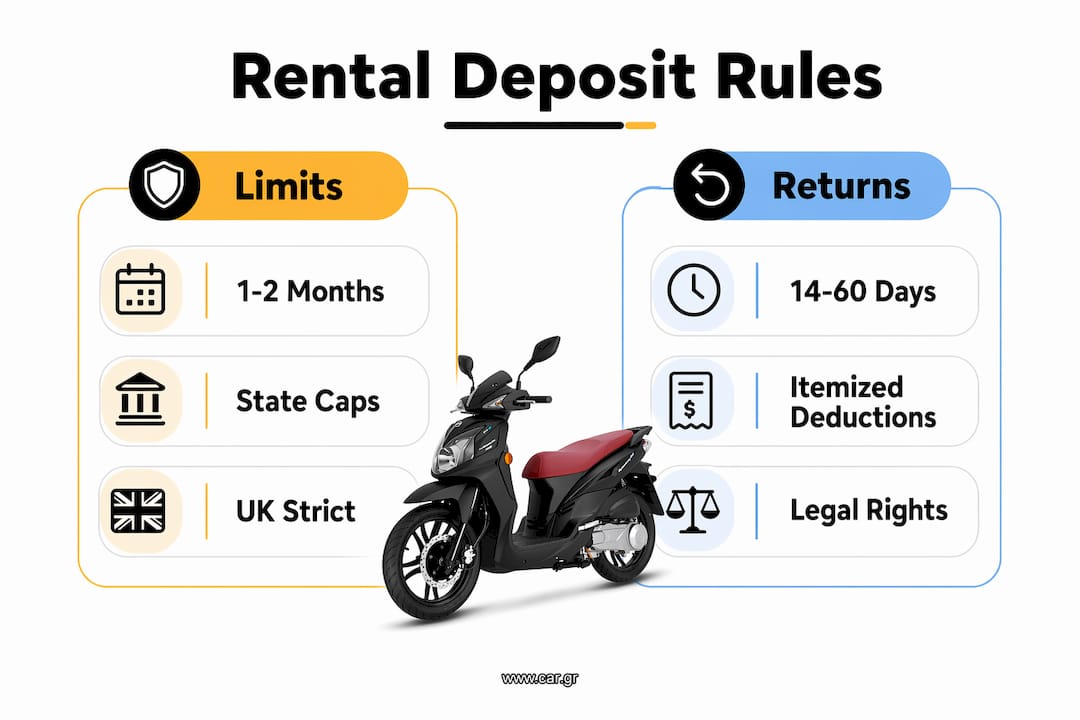
In the UK, the rules are particularly strict. Landlords cannot ask for deposits exceeding 5 weeks' rent for lower annual rents, and all deposits must be registered with a government-approved tenancy deposit protection scheme within 30 days of receipt. Holding deposits in the UK are capped separately at one week's rent. That level of statutory structure is something U.S. renters rarely see at the federal level, which is why checking your specific state law matters so much.
Pro Tip: Search your state's attorney general website for the exact deposit cap and return deadline that applies to your lease. This takes five minutes and gives you the legal baseline before you negotiate anything.
What can a landlord deduct from your deposit?
Landlords can only deduct costs tied to three categories: unpaid rent, damage that exceeds normal wear and tear, and cleaning required to restore the unit to its move-in condition. Deductions for routine painting or cosmetic improvements are generally illegal. A landlord who repaints a wall because the paint has faded over three years cannot charge that to your deposit. A landlord who repaints because you drew on the wall can.
Normal wear and tear is the key phrase in every deposit dispute. It refers to the gradual deterioration that happens through ordinary use: small nail holes from hanging pictures, light carpet wear from foot traffic, or minor scuffs on baseboards. Damage, by contrast, is caused by negligence or misuse: a broken door hinge, a stained carpet from a pet accident, or a cracked tile.
Permitted deductions typically include:
- Unpaid rent or utility bills owed under the lease
- Repair of damage beyond normal wear and tear (broken fixtures, holes in walls)
- Deep cleaning if the unit is left in a significantly dirtier state than at move-in
- Replacement of items the tenant removed or destroyed
Deductions that are generally not permitted include:
- Repainting due to normal fading or minor scuffs
- Replacing carpet that has simply aged with normal use
- General maintenance or upgrades the landlord planned regardless of the tenant's behavior
- Repairs for pre-existing damage that was present at move-in
Pro Tip: Document the unit's condition at move-in with timestamped photos and a written checklist. Share a copy with your landlord by email the day you move in. That single step resolves the majority of deposit disputes before they start.
How does the deposit refund process work?
Deposits are refundable by law when a tenant meets the lease terms, vacates on time, and leaves the unit in acceptable condition. Return deadlines range from 14 to 60 days after move-out depending on state law. Missing that window is not a minor oversight. Many states penalize landlords who fail to return deposits on time with double or triple damages payable to the tenant.
The refund process follows a predictable sequence:
- Move out on or before the lease end date. Late departures can complicate the timeline and give landlords grounds for additional charges.
- Return all keys, access cards, and parking passes. Unreturned items often trigger lock-change fees that come out of the deposit.
- Clean the unit thoroughly. Match the condition documented in your move-in checklist as closely as possible.
- Provide a forwarding address in writing. Landlords need this to send the refund check. Failing to provide it can pause the legal return clock in some states.
- Wait for the itemized statement. If the landlord withholds any portion of the deposit, they must send a written itemized list of deductions within the legal deadline.
If a landlord fails to return the deposit or provide an itemized statement within the required timeframe, tenants can file a claim in small claims court. Most states allow tenants to recover the full deposit plus a penalty, and some states award attorney's fees as well.
Special cases: pet deposits, holding deposits, and credit-based adjustments
Not every payment you make at lease signing is a security deposit. Security deposits are distinct from non-refundable fees such as pet fees, application fees, or move-in charges. Confusing these categories costs tenants money because they expect a refund that was never promised.
A few distinctions worth knowing:
- Pet deposits vs. pet fees. A pet deposit is refundable if no pet damage occurs. A pet fee is a one-time, non-refundable charge. Your lease will specify which applies. Read it carefully.
- Holding deposits. Some landlords charge a holding deposit to take a unit off the market while your application is processed. In the UK, holding deposits are capped at one week's rent. In the U.S., rules vary by state, and some states have no specific cap.
- Credit-based deposit adjustments. Landlords may charge higher deposits within legal limits based on a tenant's credit score or rental history. A tenant with a prior eviction or low credit score may be asked for two months' rent even in a state where one month is the norm. This is legal as long as the total stays within the statutory cap.
The most common and costly misconception tenants hold is that the security deposit can substitute for the last month's rent. Using the deposit as last month's rent is usually prohibited unless the lease or local law explicitly allows it. Doing so without permission can result in the landlord pursuing the unpaid rent through collections, even after you have moved out.
Key Takeaways
A rental deposit is a refundable security payment governed by state or national law, and understanding the rules for amounts, deductions, and refund timelines is the most direct way to protect your money.
| Point | Details |
|---|---|
| Deposit definition | A security deposit is a refundable payment held by the landlord to cover unpaid rent or damage. |
| Typical amounts | Most deposits equal 1–2 months' rent; about half of U.S. states cap the amount by law. |
| Permitted deductions | Landlords may only deduct for unpaid rent, damage beyond normal wear, or necessary cleaning. |
| Refund timeline | Return deadlines range from 14 to 60 days after move-out, depending on jurisdiction. |
| Document everything | Timestamped move-in photos and a written checklist are the strongest protection against unfair deductions. |
My take on deposit disputes after years of rental experience
Most deposit disputes are entirely avoidable. The tenant who loses money almost always skipped one step: the move-in inspection. I have seen renters forfeit hundreds of dollars over pre-existing damage they never photographed. The landlord presents a repair bill, the tenant has no counter-evidence, and the small claims process becomes a he-said-she-said situation that rarely ends well for the tenant.
The other pattern I see repeatedly is tenants treating the deposit as a financial cushion for the last month. They stop paying rent, assume the deposit will cover it, and then discover the landlord pursues them for the full month plus late fees. That assumption is almost always wrong, and the legal consequences of misusing a deposit can follow a renter into their credit history.
My honest advice: treat the deposit as money you fully intend to get back. Clean the unit before you move out, not the morning of. Schedule a walkthrough with your landlord before you hand over the keys. Put every communication about the deposit in writing. These habits take an hour of effort and save weeks of dispute.
— KONSTANTINOS
Renting with confidence starts with transparent policies
Deposit policies should never feel like a trap. At Motorent, every rental agreement is built around clarity: you know exactly what you pay upfront, what conditions apply, and how your deposit is handled from the moment you book.

Motorent serves tourists and travelers exploring Thessaloniki and Halkidiki on well-maintained scooters and motorbikes, with fully insured rentals and 24/7 support. Whether you are planning a day trip or a longer stay, you can browse the full fleet and book with confidence knowing the deposit terms are straightforward. For a deeper look at how Motorent structures its rental pricing and deposit policies, the scooter rental guide covers everything you need before you ride.
FAQ
What is a security deposit in rentals?
A security deposit is a refundable payment tenants make at lease signing, held by the landlord to cover unpaid rent or damage beyond normal wear and tear. It is returned after move-out if the tenant meets all lease conditions.
How much is a rental deposit typically?
Most rental deposits equal one to two months' rent. About half of U.S. states cap the amount by law, while others set no maximum, allowing landlords to request more based on risk.
Can a landlord keep my entire deposit?
A landlord can only keep the portion of the deposit that covers documented, legitimate costs such as unpaid rent, damage beyond normal wear, or required cleaning. Deductions for routine maintenance or cosmetic upgrades are generally not permitted.
How long does a landlord have to return my deposit?
Return deadlines range from 14 to 60 days after move-out depending on state law. Landlords who miss the deadline often face penalties, including double or triple the deposit amount owed to the tenant.
Is a pet deposit the same as a security deposit?
No. A security deposit is refundable if the unit is left in good condition. A pet fee is typically non-refundable. A pet deposit is refundable if no pet damage occurs. Your lease will specify which type applies.