
TL;DR:
- Riding on two wheels allows city exploration beyond tourist areas by experiencing neighborhoods and landmarks directly.
- Choosing the right vehicle, planning flexible routes with GPS, and wearing safety gear enhances safety and enjoyment.
Urban exploration on two wheels is the practice of discovering a city's connected neighborhoods, landmarks, and hidden corners by riding a motorcycle, scooter, or bicycle through its streets. This approach to city travel, often called two-wheeled urban touring in the travel industry, turns a map of isolated points into a living, breathing system you move through rather than observe. E-bikes and e-scooters now dominate moderate-intensity urban rides, particularly where hills and distance demand consistent speed. GPS navigation and digital route tools come standard with many rentals today, making it easier than ever to ride confidently through unfamiliar streets.
What are the best vehicle choices for urban exploration on two wheels?
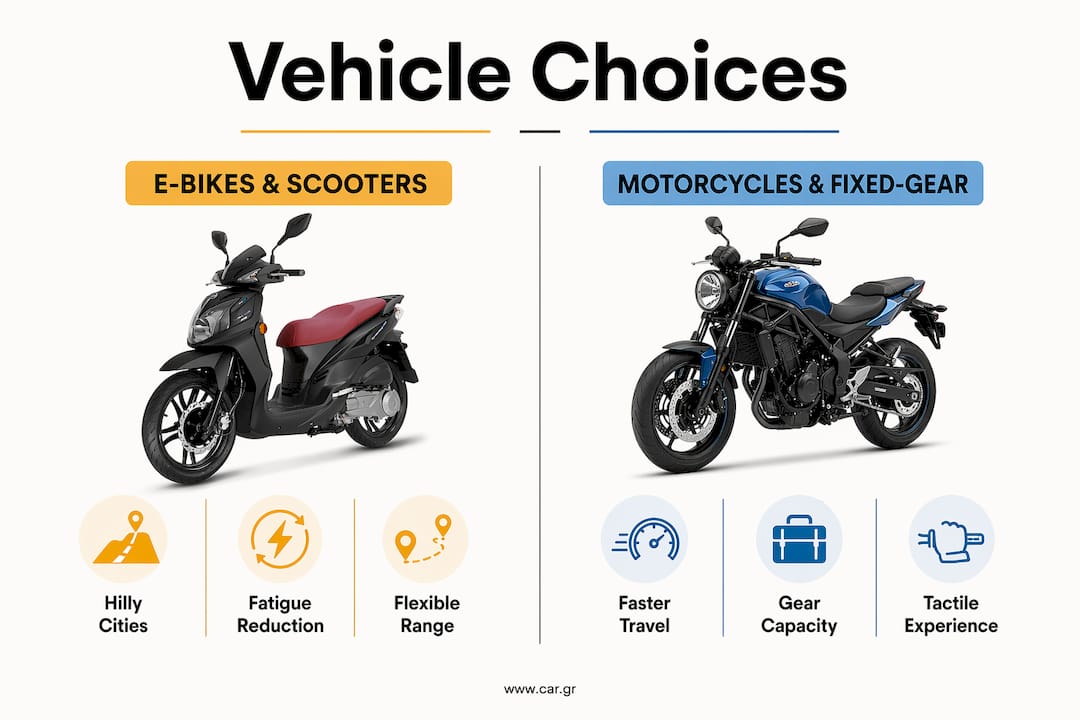
The vehicle you choose shapes every part of your city ride. Each type offers a different balance of speed, effort, sensory engagement, and range.
| Vehicle type | Best for | Key advantage | Main limitation |
|---|---|---|---|
| E-bike | Hilly cities, longer distances | Low effort, extended range | Heavier, needs charging |
| E-scooter | Short urban hops | Compact, easy to park | Limited range and speed |
| Motorcycle or scooter | Fast, multi-district rides | Speed and cargo capacity | Requires license, fuel |
| Traditional bicycle | Slow, sensory exploration | Full physical engagement | Tiring over long distances |
| Fixed-gear bike | Tactile urban discovery | Direct surface feedback | No gearing for steep hills |
E-bikes reduce fatigue on hills and extend average ride distance, making longer urban routes accessible to a wider range of riders. That matters most in cities like Thessaloniki, where coastal roads give way to steep inland streets within a few kilometers.
Motorcycles and scooters cover ground faster and carry more gear, making them the right choice when you want to move between distant districts in a single day. A scooter handles city traffic well and parks in spots a car cannot reach. For riders who want to explore Thessaloniki faster, a scooter cuts travel time between neighborhoods significantly compared to walking or waiting for transit.
Fixed-gear bikes create a different kind of experience. Every surface change, from smooth asphalt to rough cobblestone, registers immediately through the frame. That physical feedback makes the city feel more real, not just something you pass through.
Pro Tip: If you are new to a city, start with an e-scooter or e-bike for your first day. Once you know the layout, switch to a motorcycle or scooter to cover more ground on day two.
How to plan effective urban exploration routes on two wheels
Good route planning separates a frustrating ride from a memorable one. The goal is a framework you can adapt, not a rigid schedule you have to follow.
-
Set a realistic distance target. A 39 km city route balances iconic landmarks with realistic urban riding time, typically taking 3–6 hours. That range works well for a full-day ride without exhausting you before the afternoon.
-
Anchor your route on two or three landmarks. Pick fixed points that give your ride structure. Everything between them is flexible. This prevents aimless riding while leaving room for detours.
-
Mix landmark stops with neighborhood exploration. Riding past a famous monument takes thirty seconds. Stopping at a local market or side-street café gives you twenty minutes of genuine city life. The best routes alternate between both.
-
Use GPS navigation from the start. GPS self-guided tools come standard with many rental providers and prevent the most common mistake: getting lost in a one-way street maze with no data signal. Download offline maps before you leave.
-
Plan for foot exploration in historic districts. Narrow cobblestone streets in older city centers often prohibit cycling entirely. Leave your bike at the district edge and walk the last few hundred meters. This is not a detour. It is part of the experience.
-
Check traffic patterns before you ride. Morning rush hour and midday tourist crowds hit different parts of a city at different times. Riding the waterfront at 8 a.m. feels completely different from riding it at noon.
Flexible route planning consistently produces better urban exploration outcomes than rigid itineraries. Cities are unpredictable. A road closure, a street festival, or a smell from a bakery you did not expect can redirect your entire afternoon in the best possible way.
Pro Tip: Screenshot your planned route before you leave. If your GPS signal drops in a dense urban area, a static image of the route keeps you oriented without needing data.
What sensory and cultural experiences does two-wheeled urban exploration unlock?
Riding through a city on two wheels changes what you notice. A car isolates you behind glass. Public transit moves you between fixed points. A motorcycle or bicycle puts you directly inside the city's atmosphere.
Urban cycling reveals the transitions between neighborhoods that most visitors never see. The shift from a commercial district to a residential quarter happens gradually over three or four blocks. You smell the change before you see it. Bakeries, exhaust, salt air, pine trees. Each zone has its own texture.
"Blending historical landmarks and local eateries transforms the city experience on two wheels. You stop being a tourist moving between attractions and start being someone who actually lives in the city for a day." — MoodRide Tours
That shift in identity matters more than most riders expect. When you stop at a neighborhood café rather than a tourist restaurant near the main square, locals treat you differently. Conversations start. Recommendations follow. You leave with information no guidebook contains.
The sensory dimension of two-wheeled travel also changes how you remember a place. Research on travel memory consistently shows that physical engagement, effort, temperature, sound, and smell, creates stronger recall than passive observation. A ride through Thessaloniki's waterfront at dusk, with the Thermaic Gulf on your left and the White Tower lit up ahead, stays with you in a way that a taxi ride through the same street does not.
Pro Tip: Build at least two unscheduled stops into every route. Mark them on your map as blank slots. When something catches your eye, that is your stop. The best discoveries on two wheels are never planned.
What are safety and practical considerations for urban exploration on two wheels?
Safety on a city ride comes down to gear, navigation, and awareness of local rules. None of these require expert knowledge. They just require preparation.
Essential gear checklist:
- Helmet: Non-negotiable on motorcycles and scooters. Required by law in most European cities. On e-bikes, strongly recommended even where not legally required.
- High-lumen front and rear lights: Critical for riding in low light or tunnels. Many urban rides extend into evening hours.
- Reflective vest or jacket: Makes you visible to drivers at intersections, especially at dusk.
- Gloves: Protect your hands in a fall and reduce fatigue on longer rides.
- Phone mount: Keeps navigation visible without requiring you to stop and check your screen.
Helmet and lighting are the two items most riders skip when renting casually. That is also where most preventable injuries occur. A quality rental provider includes or offers these items at the point of booking.
Parking rules vary sharply between cities and even between districts within the same city. In Thessaloniki, scooters can use designated motorcycle bays and many sidewalk areas where car parking is prohibited. Always check local signage rather than assuming the rules from another city apply.
Speed limits in urban areas across Greece are typically 50 km/h on standard roads and 30 km/h in residential zones. Some historic districts restrict motorized vehicles entirely during peak tourist hours. Checking these restrictions before you ride prevents fines and wasted time.
Rental features like GPS and safety kits vary significantly between providers. Choosing a rental that includes these items built into the price is more cost-effective than sourcing them separately.
Pro Tip: Before you ride, spend five minutes checking local regulations for your specific route. A quick search for "cycling restrictions" plus the district name saves you from riding into a pedestrian zone and facing an on-the-spot fine.
Key takeaways
Two-wheeled urban exploration delivers the most rewarding city experience when you pair the right vehicle with flexible route planning, proper safety gear, and a willingness to follow what the city shows you.
| Point | Details |
|---|---|
| Choose the right vehicle | Match your vehicle to the city's terrain: e-bikes for hills, scooters for speed, fixed-gear for sensory depth. |
| Plan flexibly | Use a 30–40 km route as a framework, not a fixed schedule, and leave room for spontaneous stops. |
| Use GPS from the start | Digital navigation tools prevent getting lost and come standard with many quality rental providers. |
| Gear up before you ride | Helmet, lights, and a reflective vest are the minimum for safe urban riding in any city. |
| Mix landmarks with local stops | Combining iconic sites with neighborhood cafés and markets gives a fuller picture of any city. |
Why I think most city riders leave the best parts unseen
Most riders I have talked to plan their urban routes the same way they plan a museum visit: a list of stops in order, with estimated times at each one. That approach works fine for museums. Cities do not work that way.
The best moments I have had on two wheels in a city came from ignoring the plan. A wrong turn in Thessaloniki's Ano Poli district once led me down a staircase street I had to walk the bike down, and at the bottom was a small square with a coffee shop that had been there since the 1960s. No review, no pin on any map. Just a place that existed because the city had been there long enough to accumulate it.
The surface changes tell you more than any guidebook. When smooth asphalt gives way to worn stone, you are entering an older part of the city. When the road narrows and the buildings lean in, slow down. That is where the city keeps its character.
Timing matters more than most riders realize. The waterfront at 7 a.m. belongs to locals. By 10 a.m. it belongs to tourists. Riding the same route two hours earlier gives you a completely different city. I have started recommending that anyone doing a full-day urban ride splits it: ride the tourist-heavy areas early, then spend the afternoon in residential neighborhoods where the pace drops and the food gets better.
The riders who get the most out of city exploration on two wheels are not the ones with the best gear or the most detailed maps. They are the ones who treat the route as a starting point and the city as the actual guide.
— KONSTANTINOS
Motorent's scooter and motorbike rentals for your next city ride
Motorent offers quality scooters and motorbikes for rent in Thessaloniki and the surrounding Halkidiki region, with flexible daily and monthly rental terms suited to both short city rides and longer regional trips.

Every rental comes fully insured, and Motorent's 24/7 customer support means you are never left without help if something goes wrong mid-ride. The booking process is straightforward online, with a clear fleet overview so you can choose the right vehicle before you arrive. For riders ready to put this guide into practice, Motorent's scooter and motorbike rental guide covers the full fleet, pricing, and what is included with each rental. Thessaloniki's waterfront, Ano Poli, and the coastal roads toward Halkidiki are all within easy reach on a well-maintained Motorent scooter.
FAQ
What is urban exploration on two wheels?
Urban exploration on two wheels is the practice of riding a motorcycle, scooter, or bicycle through a city to experience its neighborhoods, landmarks, and hidden spaces as a connected system rather than isolated tourist stops.
How far should I ride on a city exploration day trip?
A 39 km route covering major landmarks and neighborhood transitions takes roughly 3–6 hours and represents a practical full-day urban ride for most riders.
Do I need a GPS device for urban biking adventures?
GPS navigation is strongly recommended. Many rental providers include turn-by-turn GPS tools at no extra cost, and offline maps prevent getting lost when data signals drop in dense city areas.
What safety gear is required for city riding?
A helmet, high-lumen lights, and a reflective vest are the core requirements. On motorcycles and scooters in Greece, a helmet is legally mandatory.
Are e-bikes or scooters better for exploring cities by bike?
E-bikes work best for hilly terrain and longer distances with less fatigue. Scooters cover ground faster and handle multi-district routes more efficiently, making them the stronger choice for full-day city exploration.