

TL;DR:
- Customer service in rentals includes all interactions from inquiry to vehicle return, shaping traveler satisfaction and loyalty. High standards demand quick responses, proactive communication, and effective support tools, which reduce frustration and build trust. When issues occur, a structured service recovery approach turns problems into opportunities for repeat business.
Customer service in rentals is defined as every interaction, communication, and support touchpoint a provider delivers from first inquiry through vehicle return. The role of customer service in rentals goes far beyond answering questions. It determines whether a traveler feels confident, informed, and cared for at every stage of the rental process. High-performing rental businesses target under 30-minute response times with a 76% first-contact resolution rate. That benchmark exists because travelers who get fast, accurate answers rarely abandon bookings or leave negative reviews. Motorent, operating in Thessaloniki and Halkidiki, treats these standards as the floor, not the ceiling.
What key customer service practices should travelers expect from rental providers?
The best rental providers build their service around speed, clarity, and proactive communication. Travelers who know what to expect can spot quality providers before they ever hand over a credit card.

Response time and first-contact resolution
A rental provider's response time is the clearest signal of operational quality. The industry standard is a reply within 30 minutes for initial inquiries. First-contact resolution at 76% means that three out of four travelers get their issue fully resolved in a single interaction. When a provider misses that mark, travelers end up repeating themselves across multiple channels, which erodes trust fast.
Self-service tools that answer common questions
Self-service resources such as FAQs, digital portals, and automated booking confirmations handle around 80% of routine inquiries. That figure matters because it means most of your pre-trip questions, pickup instructions, documentation requirements, fuel policies, should already be answered before you need to contact anyone. Providers who invest in these tools respect your time and reduce friction at every step.
Two-way communication channels
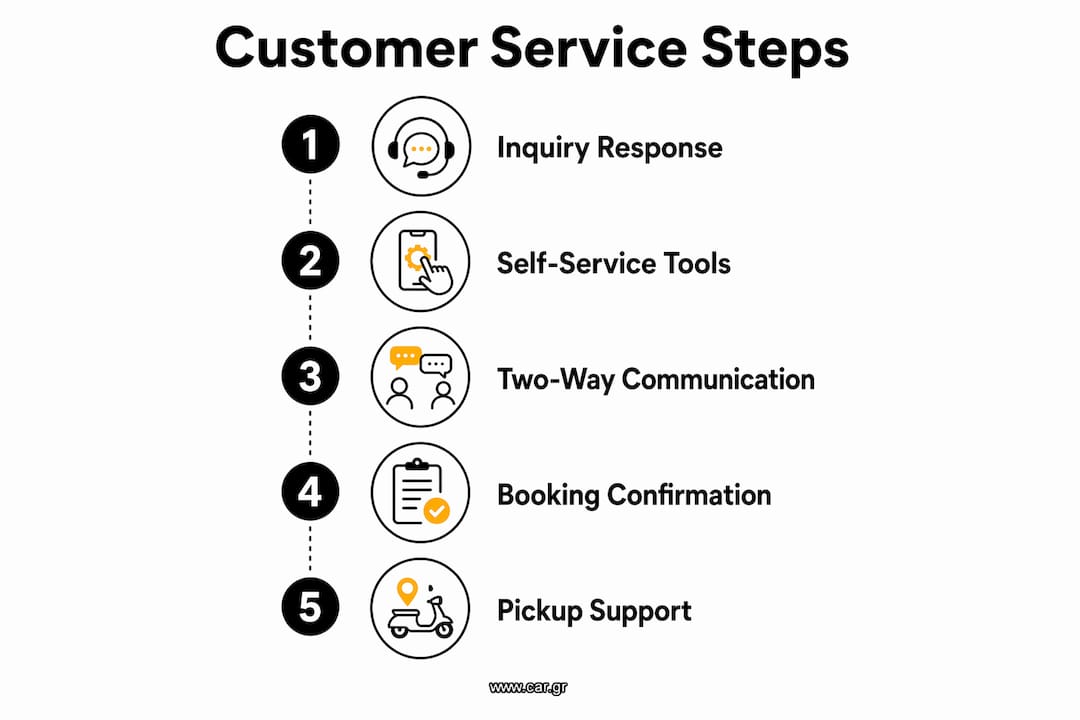
Two-way in-app messaging keeps the full conversation in one place, so neither you nor the provider loses context. This matters most when something changes, like a pickup time shift or a vehicle substitution. A provider relying only on email threads or phone calls creates gaps where details fall through.
Here are the key customer service touchpoints travelers should expect throughout a rental:
- Pre-booking: Clear pricing, availability confirmation, and insurance details
- Post-booking: Automated confirmation with pickup instructions, required documents, and contact info
- Day of pickup: Real-time messaging access and a clear handover process
- During rental: Accessible support for roadside questions or route help
- Return: Transparent inspection process and prompt deposit release
Pro Tip: Check your booking confirmation email carefully. A quality provider includes pickup location details, required ID, fuel policy, and an emergency contact number. If any of those are missing, contact the provider before your trip starts.
How does excellent customer service improve rental satisfaction and reduce issues?
Customer service is the primary competitive differentiator in the rental industry, directly linked to higher loyalty, more repeat bookings, and lower acquisition costs. That connection is not abstract. Travelers who feel supported during a rental return. Those who feel ignored or misled do not, and they write reviews that warn others away.
The loyalty loop
Repeat bookings are the most cost-effective revenue a rental business can generate. When a traveler has a smooth experience backed by responsive support, they book again without needing to be convinced. Providers who keep churn below 15% do so by resolving issues quickly and following up after problems occur. The follow-up step is where most providers fail, and it is exactly where loyalty is won or lost.
How service recovery works
The standard framework for handling complaints in the rental industry follows five steps: empathy, triage, resolve, compensate, and follow-up. This structured approach converts dissatisfied travelers into loyal repeat renters when applied consistently. The follow-up step is the most overlooked. A simple message after resolution, asking if everything was sorted, signals that the provider genuinely cares.
"Frictionless interactions that combine authenticity, responsiveness, and empathy improve the renter experience most when paired with supportive technology. Neither the human touch nor the digital tool works as well alone."
The impact on online reviews is direct. Travelers who experience good service recovery leave reviews that describe the problem and the fix. Those balanced reviews build more trust than five-star reviews that never mention a challenge. Providers who understand this treat every complaint as a reputation opportunity.
- Acknowledge the issue immediately without deflecting or blaming the traveler
- Diagnose the root cause before offering a solution
- Resolve with a concrete action, not a vague promise
- Compensate proportionally when the provider caused the problem
- Follow up within 24 hours to confirm the traveler is satisfied
How can travelers use customer support to have smoother rental experiences?
Travelers who engage customer support proactively get better outcomes than those who wait for problems to escalate. The role of customer support in rentals is not just reactive. It is a resource you can use before, during, and after your rental to protect your time and money.
Start with self-service before calling
Automated pre-arrival communications from quality providers eliminate up to 80% of common support questions before travelers even think to ask them. Check the provider's FAQ page and your confirmation email first. Most pickup logistics, document requirements, and cancellation terms are already documented. Calling for information that is already written down wastes your time and the provider's.
Ask the right questions before booking
The questions you ask before booking reveal how a provider operates. A provider who answers clearly and quickly before you pay will behave the same way after. A provider who is vague or slow at the inquiry stage will not improve once they have your money.
Questions worth asking upfront:
- What documents do I need at pickup?
- What is covered under the insurance, and what is not?
- How do I reach you if something goes wrong during the rental?
- What is your process if the vehicle has a mechanical issue?
- Is there a late return fee, and how is it calculated?
Recognize a trustworthy provider
Trustworthy providers respond within 30 minutes, give complete answers, and confirm bookings with detailed written instructions. They also offer a direct contact method for during-rental support, not just a general inbox. For travelers renting scooters or motorbikes in Thessaloniki, understanding how pickup works in advance removes the most common source of day-one stress.
Pro Tip: Screenshot or save your booking confirmation, the provider's contact number, and the insurance policy reference before you travel. If you lose connectivity abroad, you will have everything you need offline.
What are common customer service pitfalls in rentals and how are providers improving?
The most common failures in rental customer service follow a predictable pattern: slow responses, fragmented communication, and unclear policies. These problems frustrate travelers and drive negative reviews. The good news is that the rental industry is addressing them with digital-first systems and structured service standards.
Common pitfalls travelers encounter
Long wait times remain the top complaint. A traveler waiting hours for a reply about a pickup location or a vehicle issue loses confidence in the provider immediately. Fragmented communication, where one agent handles the inquiry and a different one handles the complaint, forces travelers to repeat themselves and creates errors. Unclear policies around fuel, damage deposits, and late returns generate disputes that damage both parties.
How the industry is fixing these problems
Proactive communication and digital-first service are now baseline expectations in 2026, not differentiators. Providers who have not adopted integrated messaging and automated pre-arrival communications are losing travelers to those who have. The shift is measurable: operators using in-app two-way messaging report faster resolution times and fewer repeat contacts on the same issue.
| Common pitfall | Industry solution | Traveler benefit |
|---|---|---|
| Slow initial response | Automated acknowledgment within minutes | Immediate confirmation the inquiry was received |
| Fragmented channels | Centralized in-app messaging | Full conversation history in one place |
| Unclear policies | Pre-arrival FAQ automation | Answers before questions arise |
| Poor complaint handling | Empathy-triage-resolve-compensate-follow-up framework | Structured resolution with follow-up |
| No post-rental contact | Automated review and feedback requests | Closure and opportunity to flag issues |
For a broader view of customer service best practices across travel and transportation, the standards being applied in 2026 reflect a clear shift toward digital-first, human-backed support.
Pro Tip: If a provider's website has no FAQ section and their confirmation email contains only a booking number, treat that as a warning sign. Quality operators document everything in advance because it protects both parties.
Key Takeaways
Strong customer service in rentals is the single most reliable predictor of a smooth, satisfying rental experience for travelers.
| Point | Details |
|---|---|
| Response time matters | Providers targeting under 30-minute replies and 76% first-contact resolution keep travelers confident and churn low. |
| Self-service reduces friction | FAQs and automated confirmations answer up to 80% of common questions before travelers need to ask. |
| Service recovery builds loyalty | The empathy-triage-resolve-compensate-follow-up framework turns complaints into repeat bookings when applied consistently. |
| Ask questions before booking | A provider's speed and clarity at the inquiry stage predicts how they will perform during your rental. |
| Two-way messaging is the standard | Centralized in-app communication reduces resolution time and prevents the frustration of repeating yourself. |
What I've learned about customer service after years of watching rentals go wrong
Most travelers focus on price and vehicle availability when choosing a rental provider. That is understandable. But after watching countless rental experiences unfold, the pattern is clear: the rentals that go smoothly are almost never about the vehicle. They are about the provider's communication.
The travelers who have the worst experiences are not always the ones who encounter problems. Problems happen in every rental business. The travelers who leave furious are the ones who encountered a problem and got silence, deflection, or a runaround in response. A flat tire handled with a fast call, a replacement vehicle, and a follow-up message becomes a story travelers tell positively. The same flat tire handled with a three-hour wait and no communication becomes a one-star review.
Authentic, empathetic service paired with good technology is what separates providers worth booking from those worth avoiding. Technology alone does not fix a bad experience. A chatbot that sends the wrong pickup address is worse than no chatbot at all. The providers getting this right in 2026 use automation to handle the predictable and humans to handle the unexpected.
My advice to any traveler: read the reviews, but read them for how the provider handled problems, not just whether problems occurred. A provider with a 4.3-star average and ten reviews describing fast, helpful responses to issues is a safer bet than a 4.8-star average built entirely on problem-free trips. The real test of customer service only shows up when something goes wrong.
— KONSTANTINOS
Motorent's approach to customer service in Thessaloniki rentals
Motorent builds its rental experience around the service standards that matter most to travelers: fast responses, clear pre-arrival communication, and accessible support throughout the rental. Every booking through Motorent includes full insurance details, pickup instructions, and a direct contact channel before you arrive.
Travelers planning to explore Thessaloniki or Halkidiki by scooter or motorbike can browse the full fleet and book with confidence knowing that 24/7 support is part of every rental. The scooter and motorbike rental guide covers everything from documentation requirements to daily rates, so you arrive prepared. Motorent's commitment to transparent, responsive service means fewer surprises and more time enjoying the road.
FAQ
What is the role of customer service in rentals?
Customer service in rentals covers every support interaction from initial inquiry through vehicle return, including communication, problem resolution, and post-rental follow-up. It directly determines traveler satisfaction, loyalty, and the likelihood of repeat bookings.
How quickly should a rental provider respond to inquiries?
The industry benchmark is a response within 30 minutes for initial inquiries, with a 76% first-contact resolution rate. Providers who meet this standard keep customer churn below 15%.
How do customer reviews reflect rental service quality?
Reviews reveal how a provider handles problems, not just whether trips went smoothly. Travelers should look for reviews that describe a specific issue and how the provider resolved it, since those accounts show real service quality under pressure.
What self-service tools should I expect from a quality rental provider?
Quality providers offer FAQs, automated booking confirmations, and digital portals that cover up to 80% of common questions about pickup, documentation, and policies before you need to contact anyone.
What questions should I ask a rental provider before booking?
Ask about required documents, insurance coverage details, the contact method for during-rental support, and the process for mechanical issues. A provider who answers these questions clearly and quickly before payment will deliver the same quality of service after.