

TL;DR:
- Rental liability insurance covers third-party injury and property damage caused by rental vehicles, but not damage to the vehicle or personal belongings. Many renters overlook the limits of their auto policies and credit card coverage, risking significant personal expenses during accidents. Buying supplemental coverage is especially important for international rentals, liability-only policies, or renting non-standard vehicles like scooters and motorcycles.
Rental liability insurance is a policy that covers your financial responsibility for bodily injury and property damage you cause to other people while using a rented vehicle. It does not cover damage to the rental vehicle itself, your personal belongings, or your own medical bills. Renters who skip this coverage and cause an accident face direct exposure to third-party lawsuits, settlement costs, and legal fees. Understanding what rental liability insurance covers, how it interacts with your existing policies, and when you actually need it can save you from a costly mistake at the rental counter.
What does rental liability insurance cover?
Rental liability insurance, formally called Supplemental Liability Insurance (SLI) in the rental industry, pays for third-party claims when you cause an accident in a rented vehicle. Specifically, it covers bodily injury and property damage to other people, not to you or the rental vehicle. Coverage limits typically start around $100,000 but can be increased with SLI.

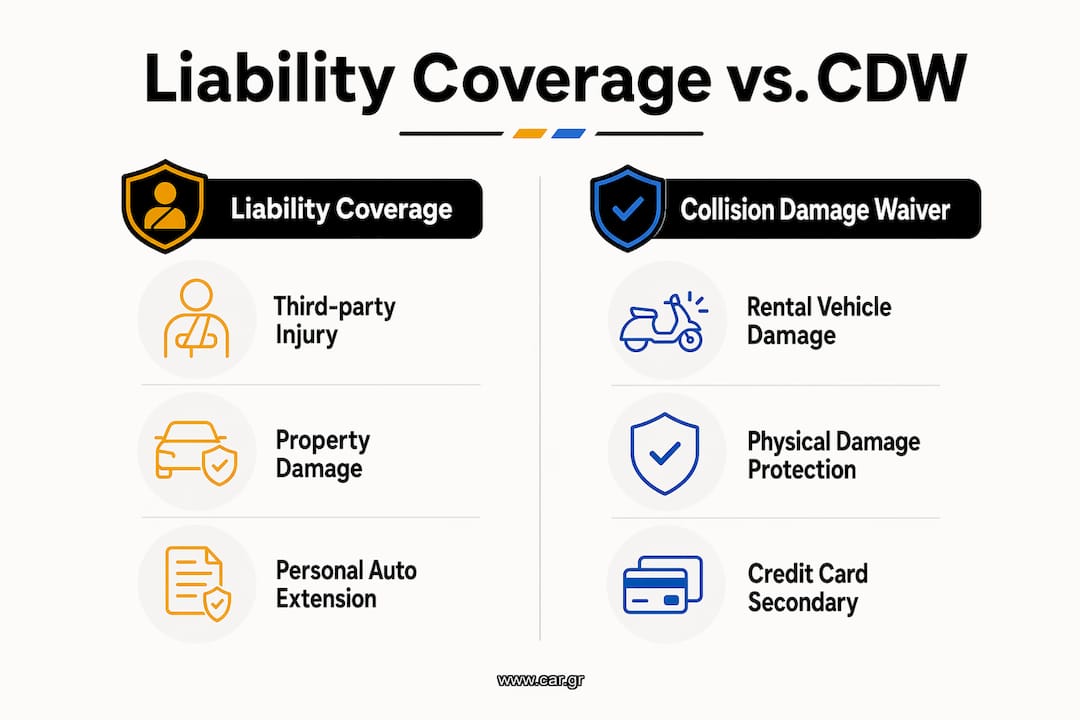
Rental liability insurance does not cover physical damage to the rental vehicle. That protection falls under a Collision Damage Waiver (CDW), which is a separate product. CDW typically costs $15–$30 per day at the rental counter, while SLI adds an additional daily fee on top of that.
Rental liability vs. renters (housing) insurance
Renters insurance for housing is a completely different product. It covers liability for injuries or property damage that happen inside your rental home, not on the road. Renters housing insurance starts at $100,000 in liability coverage and costs roughly $15–$30 per month. Vehicle rental liability insurance covers incidents that happen while you are operating a rented vehicle on public roads. The two products serve entirely separate situations.
| Coverage Type | What It Covers | Typical Cost |
|---|---|---|
| Supplemental Liability Insurance (SLI) | Third-party bodily injury and property damage from rental vehicle use | Varies by provider; daily add-on fee |
| Collision Damage Waiver (CDW) | Physical damage to the rental vehicle itself | $15–$30 per day |
| Renters (housing) insurance liability | Injuries or property damage inside your rental home | $15–$30 per month |
| Personal auto policy liability | Third-party claims from your own or rented vehicles (varies by policy) | Included in your existing premium |
Pro Tip: Many renters confuse CDW with liability coverage. CDW protects the rental company's vehicle. SLI protects other people. You may need both, and they are sold separately.
How does rental liability interact with your personal auto policy?
Your personal auto policy often extends liability coverage to rental vehicles, but the details matter. Most standard personal auto policies cover rental cars of a similar type to your own vehicle. However, personal auto and credit card policies frequently exclude specialized vehicles such as scooters, motorcycles, and exotic cars. If you rent a scooter in Thessaloniki and your personal policy excludes two-wheeled vehicles, you have zero liability coverage unless you purchase it separately.
Credit cards add another layer of confusion. Many travelers assume their card covers everything at the rental counter. Credit card rental benefits typically provide secondary CDW coverage and generally exclude liability entirely. That means your card may help pay for damage to the rental vehicle, but it will not protect you if you injure someone else.
Renters who carry liability-only personal auto policies face the biggest gap. Their policy covers third-party claims from their own car but may have low limits that do not adequately cover a serious accident in an unfamiliar location.
Key situations where your existing coverage likely falls short:
- You are renting a scooter, motorcycle, or other non-standard vehicle
- You are renting outside your home country
- Your personal auto policy carries a high deductible
- You carry liability-only coverage with low limits
- You are relying solely on a credit card for rental protection
Pro Tip: Before you rent, call your auto insurer and ask two specific questions: Does my policy extend to this vehicle type? Does it apply in this country? Get the answer in writing if possible.
Who needs rental liability insurance?
The decision to purchase rental liability coverage depends on your existing coverage, the vehicle type, and where you are renting. Renters with high deductibles or liability-only policies are the strongest candidates for supplemental coverage. A serious accident can generate third-party claims that far exceed standard personal policy limits.
Renters traveling internationally face a separate problem. Personal auto policies issued in the United States rarely extend to rentals in Greece, Spain, or other countries. Local legal requirements for minimum liability coverage vary, and being underinsured in a foreign country means you absorb the difference personally.
The cost-benefit calculation is straightforward. Rental vehicle liability coverage adds a modest daily fee. A single third-party injury claim without coverage can result in legal defense costs, settlements, and loss-of-use fees from the rental company that total tens of thousands of dollars.
Use this decision process before your next rental:
- Check your personal auto policy. Confirm it covers the specific vehicle type and rental location.
- Review your coverage limits. Low limits or liability-only coverage signals a gap.
- Check your credit card terms. Confirm whether it provides liability coverage or only CDW, and verify excluded vehicle types.
- Assess the rental location. International rentals almost always require separate liability coverage.
- Calculate your financial exposure. Compare the daily cost of SLI against the potential out-of-pocket cost of an uninsured third-party claim.
For travelers renting scooters or motorcycles, the scooter insurance guide for Thessaloniki provides specific guidance on local coverage requirements and what to verify before you ride.
Common misconceptions about rental liability coverage
The most widespread mistake renters make is assuming rental liability insurance covers everything. It does not. Rental liability coverage does not include the renter's personal belongings, the renter's own medical expenses, or damage to the rental vehicle. Each of those requires a separate product.
A second common error is declining counter insurance while underinsured. Declining CDW only makes financial sense when your personal policy has a low deductible and confirmed coverage for that specific vehicle type. Renters who skip CDW and then discover their personal policy excludes the vehicle type face the full repair bill out of pocket.
Credit card limitations catch many renters off guard. Cards that advertise rental insurance benefits often exclude liability coverage entirely and restrict CDW to specific vehicle categories or countries. Reading the card's benefits guide before relying on it is not optional.
Common coverage gaps renters overlook:
- Personal belongings stolen from or damaged in the rental vehicle are not covered by liability insurance
- The renter's own injuries require separate personal injury protection or health insurance
- Loss-of-use fees charged by the rental company while the vehicle is being repaired are often excluded from basic policies
- Proof of coverage must be available at the time of an incident, not just at the rental counter
Pro Tip: Carry a printed or digital copy of your insurance declarations page when you rent. If an incident occurs, you need proof of coverage immediately, not days later when you can reach your insurer.
For a full breakdown of what to check before you ride, the guide on inspecting a rental scooter covers the pre-ride steps that also apply to insurance verification.
Key Takeaways
Rental liability insurance covers third-party bodily injury and property damage from rental vehicle use, and it is separate from CDW, personal auto policies, and renters housing insurance.
| Point | Details |
|---|---|
| Liability vs. CDW | SLI covers third-party claims; CDW covers damage to the rental vehicle. Buy both if needed. |
| Personal policy gaps | Most personal auto policies exclude scooters, motorcycles, and international rentals. |
| Credit card limits | Credit cards rarely cover liability; they typically offer secondary CDW only. |
| Who needs SLI most | Liability-only policyholders, international renters, and scooter or motorcycle renters. |
| Proof of coverage | Carry documentation at the time of rental, not just at booking. |
Why I always verify coverage before I rent anything
Travelers consistently underestimate how narrow their existing coverage actually is. I have spoken with renters who were certain their credit card covered everything, only to discover the card excluded motorcycles and non-EU rentals. That is not a minor gap. That is full personal financial exposure on a vehicle they were riding through unfamiliar roads.
The piece of advice most renters ignore is this: liability-only policies feel sufficient until they are not. A small premium increase for fuller coverage, whether on a personal auto policy or through SLI at the rental counter, provides protection that a liability-only policy simply cannot match. The math almost always favors buying the supplemental coverage when you are renting a non-standard vehicle or traveling internationally.
Reading the fine print is not exciting, but it is the only way to know what you actually have. Before any rental, I pull up the declarations page of my auto policy, check the credit card benefits guide, and confirm the rental company's own insurance terms. That takes 15 minutes and eliminates the guesswork entirely. The renters who skip that step are the ones who find out what they were missing after an accident.
— KONSTANTINOS
Motorent makes rental insurance straightforward
Renting a scooter or motorcycle should not require a law degree to understand the insurance terms. Motorent offers fully insured rentals across its fleet of scooters and motorbikes in Thessaloniki and Halkidiki, with clear coverage details built into every booking.

Motorent's 24/7 customer support means you can ask coverage questions before you ride, not after something goes wrong. Whether you are a first-time scooter renter or a regular traveler exploring northern Greece, the scooter rental options in Thessaloniki include insurance guidance so you know exactly what is covered. Browse the full Motorent fleet to find the right vehicle for your trip and confirm the coverage that comes with it.
FAQ
What is rental liability insurance in simple terms?
Rental liability insurance pays for bodily injury and property damage you cause to other people while driving a rented vehicle. It does not cover the rental vehicle itself or your own injuries.
Does my personal auto insurance cover rental vehicles?
Most personal auto policies extend liability coverage to standard rental cars, but many exclude motorcycles, scooters, and international rentals. Always confirm the specific vehicle type and rental country with your insurer before you rent.
Does my credit card cover rental liability?
Credit cards typically provide secondary CDW for vehicle damage but exclude liability coverage entirely. Relying solely on a credit card leaves you personally exposed to third-party injury and property damage claims.
Is rental liability insurance the same as renters insurance?
No. Renters insurance covers liability for incidents inside your rental home and starts at $100,000 in coverage for roughly $15–$30 per month. Rental vehicle liability insurance covers incidents that occur while operating a rented vehicle on public roads.
When should I buy supplemental liability insurance at the rental counter?
Buy SLI when your personal auto policy excludes the vehicle type, when you are renting internationally, or when your existing liability limits are low. High deductibles and liability-only policies are the clearest signals that supplemental coverage is worth the daily cost.