

TL;DR:
- A rental cancellation policy outlines the rules for booking cancellations, refunds, and fees. Knowing the policy tier helps travelers assess their financial risk before confirming a reservation. Proactive communication and choosing flexible rates reduce unexpected charges and protect your travel budget.
A rental cancellation policy is the set of rules that determines whether you can cancel a booking, what refund you are entitled to, and what fees apply if you cancel late or not at all. Every rental agreement carries cancellation terms, whether you are booking a vacation apartment, a car, or a scooter for a week in Thessaloniki. These terms directly affect your money, so reading them before you confirm a reservation is not optional. The industry standard divides policies into three tiers: Flexible, Moderate, and Strict/Non-refundable. Knowing which tier applies to your booking tells you exactly how much financial risk you are taking on.
What is a rental cancellation policy and why does it matter?
A rental cancellation policy sets the specific rules governing if and how a traveler can cancel a booking, what refunds they are entitled to, and any applicable penalties. Cancellation policies serve as risk-allocation tools that balance the traveler's financial exposure against the supplier's need to protect revenue. That balance explains why the terms vary so widely across rental types and providers.

Short-term rentals, vehicle rentals, and equipment rentals all use cancellation clauses, but the structure differs. A scooter rental in Halkidiki may allow free cancellation up to 24 hours before pickup. A vacation apartment may require 14 days' notice. A longer-term lease may demand 30 days' written notice by certified mail. Understanding which rules apply to your specific booking prevents costly surprises.
Travelers who skip the cancellation terms often discover them at the worst possible moment, when a flight gets delayed or a travel plan changes. Checking the policy at booking time, not at cancellation time, is the only way to make an informed decision about which rate to choose.
What are the most common rental cancellation policy types?
Cancellation policies are tiered as Flexible, Moderate, or Strict/Non-refundable, and each tier carries different refund conditions and pricing.
Flexible policies allow cancellations up to 24–48 hours before pickup or check-in for a full refund. These are the lowest-risk option for travelers whose plans may change. The trade-off is a slightly higher daily rate compared to non-refundable bookings.
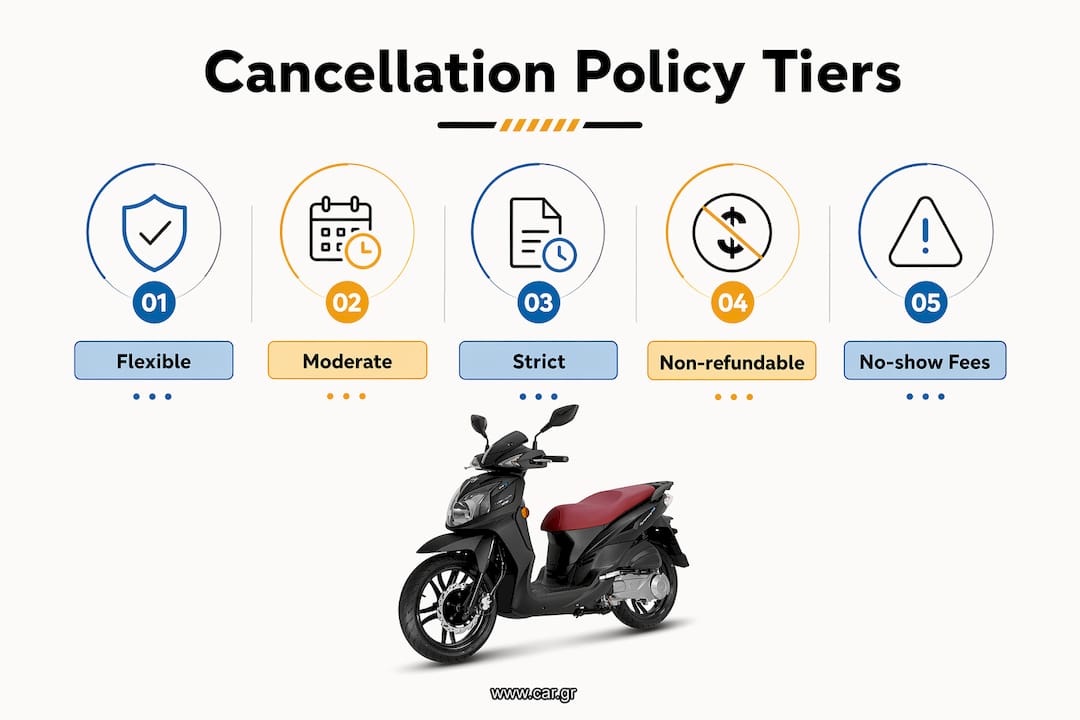
Moderate policies set an earlier cutoff, typically 5–14 days before the rental start date. Cancellations inside that window result in a partial refund, often 50% of the total reservation value. Cancellations outside the window receive a full refund.
Strict or Non-refundable policies offer no refund regardless of when you cancel. In exchange, non-refundable bookings typically offer a 10–15% discount off the standard rate. That discount is the supplier's incentive for you to accept full cancellation risk upfront.
The tier that applies also depends on the rental category:
- Vehicle and scooter rentals: Usually Flexible or Moderate, with 24–48 hour free cancellation windows common.
- Short-term vacation rentals: Often Moderate or Strict, with 5–14 day cutoffs and partial refund structures.
- Medium to long-term rentals: Typically contractual, requiring written notice 14–30 days in advance with deposit forfeiture for non-compliance.
Pro Tip: Always compare the discount on a non-refundable rate against your actual risk of canceling. If your trip has any uncertainty, paying the slightly higher flexible rate is almost always the better financial decision.
How do cancellation windows and fees work in practice?
Most rental cancellation policies use a cutoff window of 24–48 hours before pickup or check-in for full refunds. Cancellations after that window trigger fees that range from a single-night penalty to 100% of the total reservation cost.
Typical cutoff windows by rental type
The window varies significantly depending on what you are renting and for how long:
- 24-hour window: Standard for daily scooter, motorbike, and car rentals. Cancel before this point and you pay nothing.
- 48-hour window: Common for multi-day vehicle rentals and some short-term vacation properties.
- 5 to 14-day window: Typical for vacation rentals booked through online platforms.
- 14 to 30-day window: Required for medium-term and long-term rental agreements, often with written notice obligations.
Refund processing times
Car and equipment rental refunds are processed within 5 business days in most cases, though banking institutions may add additional delays. Credit card refunds often appear within 3–5 business days after the supplier processes the request. Debit card refunds can take longer depending on your bank.
No-shows versus cancellations
No-show penalties are often harsher than cancellation fees, sometimes totaling 100% of the booking cost. A no-show means the supplier loses the opportunity to rebook the vehicle or property to another traveler. Canceling proactively, even at the last minute, is almost always better than simply not showing up.
Pro Tip: If you realize you cannot make your pickup time, call or message the supplier immediately. Many providers will reduce or waive fees for travelers who communicate early, even if the policy technically allows a full charge.
What nuances and exceptions should travelers know about?
The most common misconception about rental cancellation policies is that emergencies automatically waive fees. Flight cancellations or illness do not exempt travelers from cancellation fees unless the traveler holds insurance that specifically covers trip cancellation. The rental supplier's policy applies regardless of the reason for cancellation.
What travel insurance actually covers
Travel insurance and certain credit cards offer trip cancellation coverage that reimburses non-refundable rental costs when a covered event occurs. Covered events typically include medical emergencies, severe weather, and certain travel disruptions. Before booking a strict or non-refundable rate, verify whether your credit card or travel insurance policy covers rental cancellations and what documentation is required to file a claim. A scooter insurance guide can clarify what protections apply specifically to vehicle rentals.
Modifying versus canceling
Modifying rental dates is often treated differently than cancellations and can be a way to avoid fees entirely. Many suppliers offer better terms for rebooking or shifting dates than for outright cancellations. If your plans shift by a day or two, requesting a date change through the supplier's booking portal may cost nothing, while canceling and rebooking could trigger a penalty.
Force majeure and supplier discretion
Rental suppliers rarely waive fees for force majeure events unless the policy explicitly states otherwise. Natural disasters, government travel restrictions, and similar events may qualify for waivers at the supplier's discretion, but there is no automatic right to a refund. Always read the force majeure clause in your rental agreement before assuming you are protected.
Pro Tip: Check whether your rental agreement requires written cancellation notice by email or certified mail. Verbal cancellations are rarely accepted for medium-term or long-term rentals, and failing to follow the correct procedure can forfeit your deposit.
How can travelers minimize cancellation fees and manage bookings effectively?
The most effective strategy for avoiding cancellation fees is choosing the right rate tier at the time of booking. Cancellation policy should be part of total rental cost calculations, not an afterthought. A 12% discount on a non-refundable rate means nothing if you end up canceling and losing the full amount.
Follow these steps to protect yourself:
- Assess your trip certainty before booking. If flights, weather, or health make your plans uncertain, choose a flexible rate even if it costs more upfront.
- Cancel within the free window immediately once you decide not to proceed. Waiting even one day past the cutoff can cost you a full night's charge or more.
- Use the "Manage Booking" portal to modify dates rather than cancel outright. Motorent's booking management portal lets travelers adjust reservations online without needing to call.
- Contact the supplier at the first sign of a problem. Proactive communication with rental suppliers at the earliest sign of changes can help mitigate cancellation penalties. Suppliers have more flexibility when they have advance notice.
- Verify your insurance coverage before confirming a non-refundable booking. Check your credit card benefits and any travel insurance policy for trip cancellation clauses.
- Budget for cancellation risk. Treat the potential cancellation fee as part of the total cost of the rental when comparing options.
Understanding rental agreement terms before you sign is the single most reliable way to avoid unexpected charges. Travelers who read the cancellation clause at booking time make better rate decisions and face fewer surprises.
Key Takeaways
A rental cancellation policy defines your refund rights and fee exposure, and choosing the right policy tier at booking time is the most effective way to protect your travel budget.
| Point | Details |
|---|---|
| Three standard policy tiers | Flexible, Moderate, and Strict/Non-refundable each carry different refund terms and pricing. |
| Cutoff windows determine fees | Most vehicle rentals use a 24–48 hour free cancellation window; longer rentals require 14–30 days' notice. |
| No-shows cost more than cancellations | No-show penalties often reach 100% of the booking; always cancel proactively, even at the last minute. |
| Emergencies don't waive fees automatically | Flight delays and illness only exempt you from fees if your travel insurance or credit card covers trip cancellation. |
| Modify before you cancel | Requesting a date change often avoids fees that a full cancellation would trigger. |
Why travelers consistently underestimate cancellation terms
Most travelers I have spoken with treat the cancellation policy as fine print they will deal with if something goes wrong. That is exactly the wrong approach. By the time something goes wrong, you are already past the free cancellation window, and the fee is locked in.
The counterintuitive reality is that a flexible rate is not just a convenience. It is a financial instrument. You are paying a small premium to transfer cancellation risk back to the supplier. When I look at the math, that premium is almost always worth it for travelers whose itineraries involve connecting flights, ferry schedules, or weather-dependent activities, which describes most trips to places like Thessaloniki and Halkidiki in the shoulder seasons.
The other mistake I see constantly is travelers assuming that calling the supplier and explaining a hardship will result in a waiver. Occasionally it does, especially when you have communicated early and built goodwill. But suppliers are not obligated to waive fees, and counting on goodwill is not a strategy. Purchasing travel insurance that explicitly covers trip cancellation is the only reliable protection against non-refundable losses.
My practical recommendation: make cancellation policy review a non-negotiable step in your booking checklist, right after you confirm the price and before you enter your payment details. It takes 60 seconds and can save you the full cost of the rental.
— KONSTANTINOS
Motorent's approach to flexible rental bookings
Knowing your cancellation terms before you book is the clearest sign of a prepared traveler. Motorent is built around that principle, offering transparent rental agreement cancellation terms and straightforward booking management for scooter and motorbike rentals in Thessaloniki and Halkidiki.

Motorent's online platform lets you browse the full fleet, confirm your dates, and manage your reservation without friction. The scooter rental guide covers everything from available models to booking terms, so you know exactly what you are committing to before you pay. For travelers who value flexibility and clear policies, Motorent's 24/7 customer support means you always have someone to contact if your plans change. Visit Motorent's main page to check availability and review the full rental terms for your trip.
FAQ
What is a rental cancellation policy?
A rental cancellation policy is the set of rules in a rental agreement that defines when and how a traveler can cancel a booking, what refund they receive, and what fees apply for late or no cancellation.
What happens if I cancel a rental after the cutoff window?
Canceling after the free cancellation window typically triggers a fee ranging from a single-night charge to 100% of the total reservation cost, depending on the policy tier and rental type.
Are no-shows treated the same as cancellations?
No-shows are penalized more severely than cancellations because the supplier loses the chance to rebook. No-show penalties often total 100% of the booking cost, while proactive cancellations may incur smaller fees.
Does travel insurance cover rental cancellation fees?
Travel insurance and some credit cards cover non-refundable rental costs when a qualifying event occurs, such as a medical emergency. Always verify the specific covered events and documentation requirements before booking a non-refundable rate.
How long does a rental cancellation refund take?
Most vehicle rental refunds are processed within 5 business days after the supplier confirms the cancellation, though your bank may add additional processing time.