

What does rental insurance coverage actually include?
Rental insurance coverage for scooters and motorcycles protects the physical vehicle, not you. The industry term is a collision damage waiver (CDW), and it covers repair costs if the rental bike gets damaged during your ride. That's where most rental shop coverage stops.
What it typically does NOT cover:
- Your medical expenses if you're injured
- Third-party liability if you injure someone else or damage their property
- Theft or vandalism of the vehicle (unless explicitly added)
- Damage caused while riding under the influence or off designated roads
- Riders not listed on the rental agreement
Most travel insurance plans exclude scooter and motorcycle usage by default, requiring explicit additions and full compliance with licensing laws. Rental counter insurance and travel insurance are two separate products solving two different problems. You need both.
Table of Contents
- 1. Legal compliance requirements that can void your claim
- 2. Rental counter insurance vs. travel insurance: what each one covers
- 3. Common misconceptions travelers have about rental insurance
- 4. How to verify and purchase adequate coverage before you ride
- 5. Coverage differences between scooter and motorcycle rentals
- 6. Third-party liability and personal injury coverage
- 7. Theft and vandalism coverage options
- 8. How international travel changes your rental insurance
- Motorent makes fully insured scooter rentals straightforward
- Key Takeaways
- FAQ
1. Legal compliance requirements that can void your claim
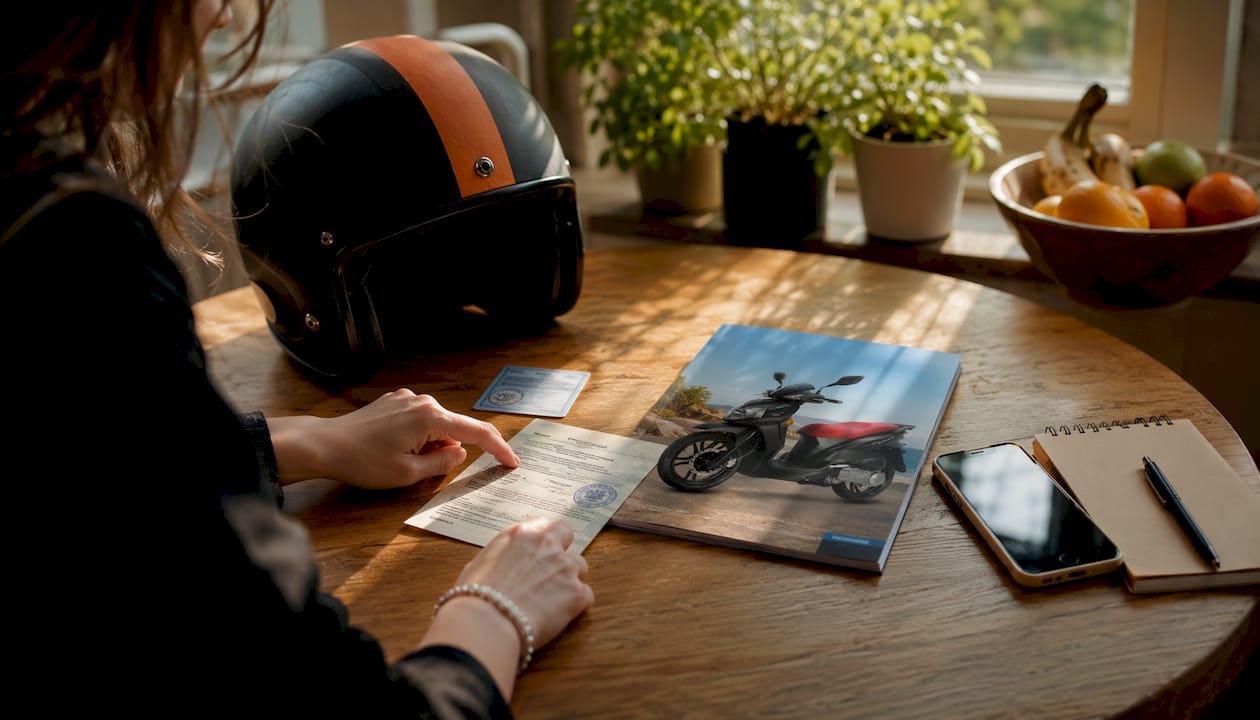
Your insurance coverage is only as good as your compliance with local law. Insurers use licensing and safety violations as grounds to deny claims outright, regardless of who caused the accident.
Key compliance requirements:
- Valid motorcycle license: Your license must match the engine class of the bike you're renting. A standard car license covers scooters under 50cc in many jurisdictions, but anything larger typically requires a motorcycle endorsement.
- International Driving Permit (IDP): Non-U.S. citizens visiting the United States, and Americans renting abroad, often need an IDP alongside their national license. Riding without correct licensing documents voids medical and liability coverage under travel insurance, regardless of fault.
- Helmet use: Mandatory in most states and most tourist destinations worldwide. Skipping a helmet doesn't just risk your head. It voids your policy.
- Sober riding: Any alcohol or non-prescribed drug use at the time of an accident typically triggers a full exclusion.
Pro Tip: Carry physical copies of your license, IDP, and insurance certificate. A photo on your phone is fine as backup, but rental agencies and police often require originals. Check local helmet laws before you arrive, not at the rental counter.
Insurance adjusters treat full legal compliance as mandatory. Minor infractions frequently cause complete claim denial.
2. Rental counter insurance vs. travel insurance: what each one covers
These two products are often confused, and that confusion costs travelers money.
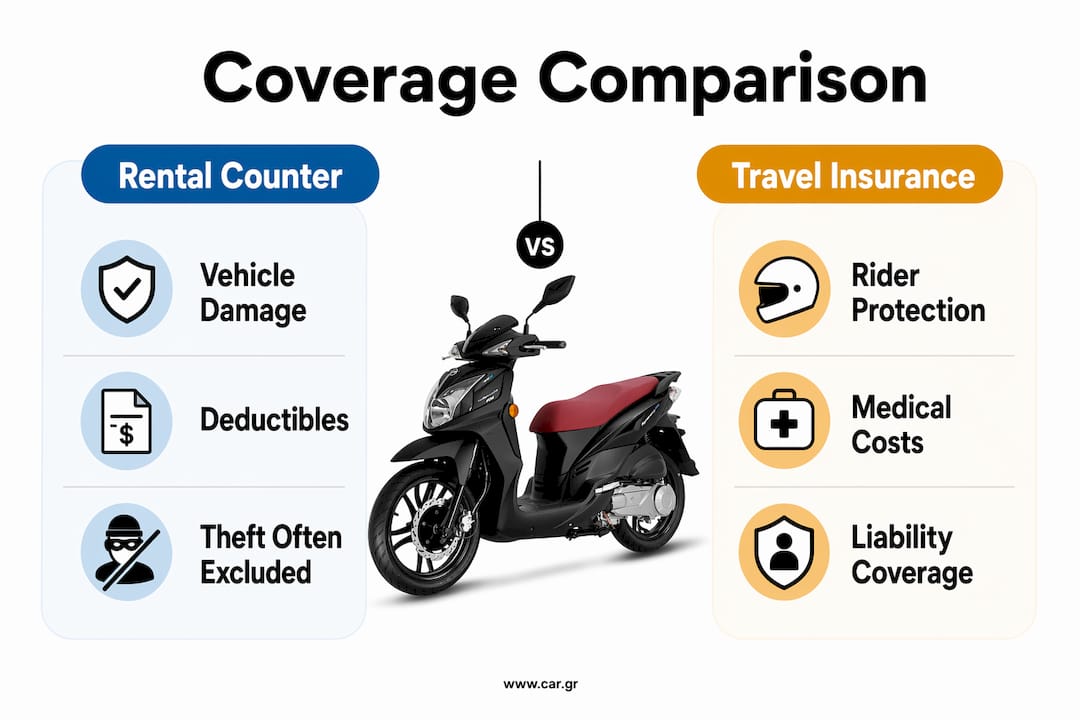
Rental counter insurance (CDW) covers damage to the vehicle itself. It typically comes with a deductible, called an excess, that you pay out of pocket before coverage kicks in. Rental counter coverage focuses on the vehicle, not comprehensive medical or liability protection. High deductibles are common, and the policy voids immediately if you breach any rental terms.
Travel insurance covers you, the rider. Medical treatment, emergency evacuation, trip interruption, and sometimes third-party liability all fall under this category. Rental insurance is not a replacement for personal injury or legal liability protection.
| Coverage area | Rental counter insurance (CDW) | Travel insurance |
|---|---|---|
| Vehicle damage | Yes, subject to deductible | No |
| Rider medical expenses | No | Yes, if scooters are covered |
| Third-party liability | Rarely | Sometimes, with add-on |
| Theft of vehicle | Rarely | No |
| Emergency evacuation | No | Yes |
| Trip cancellation | No | Yes |
Core limitations of each:
- CDW: high deductibles, voids on policy breaches, no personal injury protection
- Travel insurance: many policies exclude motorized two-wheelers entirely, or cap engine size
Combining both gives you the only genuinely complete protection. Neither one alone is enough.
3. Common misconceptions travelers have about rental insurance
The most dangerous assumption is that signing at the rental counter means you're fully covered. You're not.
Many travelers mistakenly assume standard travel insurance covers scooters. Most policies have engine size limits and explicit license requirements, and claim denials from this misunderstanding are common. A few other misconceptions worth knowing:
- "The rental shop said I'm insured." That usually means the vehicle has basic compulsory registration coverage, not comprehensive protection for you or your medical bills.
- "My credit card covers rentals." Credit card rental protection almost never extends to motorcycles or scooters.
- "I'll sort it out after an accident." Rental shops can demand payment at the accident scene, and riders without proper documentation have no leverage to dispute charges later.
Pro Tip: Before you sign the rental agreement, photograph every scratch, dent, and scuff on the bike. Do it in front of a staff member and timestamp the photos. This is your primary defense against false damage claims on return day.
Practical steps to protect yourself:
- Confirm insurance terms in writing before accepting the rental
- Ask specifically what the deductible amount is
- Verify whether the policy covers the roads you plan to ride on
- Check whether pillion passengers are included in the coverage
4. How to verify and purchase adequate coverage before you ride
Getting coverage right takes about 30 minutes before your trip. Skipping it can cost thousands.
- Review your existing travel policy. Call your insurer and ask specifically whether motorized two-wheelers are covered. Get the answer in writing, not a verbal assurance.
- Buy a supplemental policy if needed. If your current policy excludes scooters, purchase a separate policy that explicitly covers them, including the engine size of the bike you plan to rent.
- Compare rental agencies. Look for agencies that provide written insurance documentation and clearly explain what the rental coverage includes and what the excess is.
- Read the rental agreement before signing. Pay attention to excess fees, covered road types, and driver restrictions. Check the rental insurance checklist before you commit.
- Photograph the scooter before you ride. Document every scratch and dent at pickup. Use the pre-ride inspection guide as your checklist.
- Confirm your insurance certificate. Ask for a copy and keep it accessible on your phone and in print.
Documents to carry every time you ride:
- Valid driver's license (original)
- International Driving Permit (if required)
- Passport or national ID
- Proof of travel insurance with policy number and emergency contact
- Rental agreement and insurance certificate
Post-accident: photograph the scene before moving anything, call the rental agency immediately, obtain a police report if there's any injury or third-party damage, and notify your travel insurer the same day.
5. Coverage differences between scooter and motorcycle rentals
Engine size is the dividing line most travelers miss. A 50cc scooter and a 650cc motorcycle are not treated the same by insurers or rental agencies.
Travel insurance policies frequently cap coverage at a certain engine size threshold. Rent a larger motorcycle and you may fall outside your policy's protection entirely, even if motorcycles are technically covered. Standard travel insurance often restricts coverage by engine displacement, making explicit scooter insurance essential for anything above entry-level displacement.
Rental counter insurance also tends to differ. Larger motorcycles carry higher repair costs, so deductibles are typically higher and exclusions more detailed. Some rental agencies require a separate damage waiver for motorcycles above a certain engine size, on top of the standard CDW.
The practical rule: confirm the exact engine displacement of the bike you're renting, then verify that figure against your travel policy's stated limit before you sign anything.
6. Third-party liability and personal injury coverage
Third-party liability is the coverage most travelers never think about until they need it. If you collide with another vehicle or injure a pedestrian, you can face civil claims that far exceed any rental deposit.
Rental counter insurance rarely includes meaningful third-party liability protection. Travel insurance sometimes does, but it's usually an add-on, not a default. Riding without it in a country with active civil liability law is a serious financial risk.
Personal injury coverage works differently. Your travel insurance medical benefit covers your treatment costs if you're injured in an accident, provided you were riding legally and within policy terms. Emergency evacuation, hospital stays, and repatriation home can all fall under this benefit when the policy explicitly covers motorized two-wheelers. Verify the liability coverage details for your specific rental situation before departure.
7. Theft and vandalism coverage options
Theft protection for rental scooters is not automatic. Most CDW policies cover collision damage only, and theft requires a separate add-on or a specific clause in the rental agreement.
If the bike is stolen and you lack theft coverage, you're typically liable for the full replacement value, not just a deductible. Vandalism follows similar logic: unless your rental agreement explicitly names it as a covered event, the cost lands on you.
Travel insurance does not cover theft of or damage to the rental vehicle. That protection, when it exists, comes from the rental agency's own policy. Before renting, ask the agency directly: "Does your coverage include theft, and what is the deductible?" Get the answer in writing.
8. How international travel changes your rental insurance
Crossing a border changes almost everything about your coverage. Domestic auto policies and standard travel insurance both behave differently once you're riding abroad.
U.S. auto insurance policies do not extend to rental scooters or motorcycles in foreign countries. Your home policy is irrelevant the moment you rent a bike overseas. Travel insurance becomes your primary protection layer, and as noted, many policies exclude motorized two-wheelers or impose engine size limits that catch travelers off guard.
Local laws also affect what rental agencies are required to carry. Some countries mandate basic compulsory third-party coverage on all registered vehicles. That coverage protects other people from you, not you from injury or vehicle damage. Travelers who mistake compulsory vehicle registration insurance for personal coverage are the ones who end up paying hospital bills out of pocket. For destination-specific rules, the Thessaloniki scooter insurance guide covers what travelers renting in Greece specifically need to know.
Motorent makes fully insured scooter rentals straightforward
Sorting out rental coverage shouldn't eat half your travel day. Motorent offers fully insured scooter and motorcycle rentals in Thessaloniki and Halkidiki, with written insurance documentation included and 24/7 support if something goes wrong on the road.
The difference from booking through an unknown local shop: you get a clear rental agreement in writing, a well-maintained fleet, and staff who can actually explain what your coverage includes before you ride. No guessing at the counter, no surprise deductibles buried in fine print. Browse the fleet and check availability at the Motorent rental guide, or go straight to motorent.io to book a fully insured ride.
Key Takeaways
Rental insurance for scooters covers vehicle damage only; travelers need separate travel insurance for medical costs, liability, and evacuation, and both policies require full legal compliance to remain valid.
| Point | Details |
|---|---|
| CDW covers the vehicle, not you | Collision damage waivers pay for bike repairs but exclude rider medical costs and third-party liability. |
| Travel insurance requires explicit scooter coverage | Many standard travel policies exclude motorized two-wheelers; coverage additions and engine size confirmations are necessary. |
| License and helmet compliance is non-negotiable | Riding without the correct license or a helmet voids both rental and travel insurance, regardless of fault. |
| Document everything before you ride | Photograph all pre-existing damage at pickup to defend against false damage claims on return. |
| Motorent includes written insurance documentation | Motorent's fully insured rentals in Thessaloniki come with clear coverage terms and 24/7 rider support. |
FAQ
Does rental counter insurance cover my medical bills?
No. Rental counter insurance, or collision damage waiver, covers damage to the vehicle only. You need a separate travel insurance policy with explicit scooter coverage for medical expenses and emergency evacuation.
What voids rental insurance coverage on a scooter?
Riding under the influence, riding without a helmet, allowing an unlisted person to operate the bike, or breaching any rental agreement term typically voids coverage entirely, leaving you personally liable for all costs.
Do I need an International Driving Permit to rent a scooter abroad?
In many tourist destinations, yes. Non-U.S. citizens visiting the United States and Americans renting scooters in countries like Greece need a valid IDP alongside their national license. Riding without one can void your travel insurance claim.
Does travel insurance cover scooter theft?
No. Travel insurance does not cover theft of or damage to a rental vehicle. Theft protection, when available, comes from the rental agency's own policy as a separate add-on. Always ask the agency directly before renting.
How does engine size affect my insurance coverage?
Travel insurance policies often cap coverage at a certain engine size threshold. Renting a bike above that limit, even if motorcycles are technically covered under your policy, can leave you uninsured. Always confirm the exact engine displacement of the rental bike against your policy's stated limit.